DAV 33.561821358515914, -82.76385726213762
YRS 42.790945158685965, -89.4382364058325
CP 42.96827436240214, -89.52446509281556
Equipment
I have pursued this program with the remote photographic option, using remote photo services from Sierrastars (SSON) and Slooh. (There are only a handful of SSON photos in this program. The SSON service ceased operation soon after I began the program.) These services employ a number of telescopes, and I have used several of them for this project. Below each photo I note the scope with an abbreviation that follows this convention:
SSON – Warrumbungle in New South Wales, Austrailia = W
- Scope: PlaneWave Instruments 20″ CDK20 (Corrected Dall-Kirkham) at f/6.8
- Camera: SBIG STL6303E
- Latitude: 331:16:30.6 South
- Longitude: 149:11:40.3 East
SSON – Gemini in Sonoita, Arizona, USA = G
- Scope: PlaneWave Instruments 17″ CDK17 (Corrected Dall-Kirkham) at f/6.8
- Camera: Apogee CG42 camera
- Latitude: 31° 39′ 56.08″ North
- Longitude: 110° 36′ 06.42″ West
SLOOH – Santiago, Chile = SC 2
- Scope: PlaneWave Instruments 17″ CDK17 (Corrected Dall-Kirkham) at f/6.8
- Camera: Finger Lakes Instrument Proline PL16803 Monochrome CCD Camera
- Latitude: S33° 16′ 8.4″ S33.269
- Longitude: W070° 32′ 2.4″ W070.534
SLOOH – Canary Islands = C 3
- Scope: Celestron 11″ Rowe-Ackermann Schmidt Astrograph (RASA) at f/2.2
- Camera: Celestron Nightscape 8300 One Shot Color (OSC)
- Latitude: N28° 17′ 58.92″ N28.29970
- Longitude: W016° 30′ 29.736″ W016.50826
The SSON photos use a luminance filter and unless otherwise noted, are of 90 seconds duration. All of the SSON photos are monochrome. Slooh telescopes and cameras operate on fixed filter / exposure formulas based on the type of target in question. Sometimes they take luminance-only shots and at other times they take separate L,R,G, and B photos. I used a variety of integration techniques for the photos in this program. In general, if the photo has color in it, it is RGB or LRGB. If it is monochrome, it is a luminance shot. In some cases I found it best to turn a color photo into a mono photo in order to bring out the contrast between dark space and the objects in the field of view. In all cases, Slooh returns Luminance shots with 50 second exposures and R, G, and B shots with 20 second exposures.
Plate Solving
Part of the beauty of this endeavor (and, I suppose, the purpose of the observing program itself) is to view many galaxies in one field of view. As one begins working with the photos, one sees many, many galaxies. Using a technique called “plate solving,” I was able to identify many of the galaxies in each photo. The solvers I used were the image solver and image annotation scripts in Pixinsight as well as an online resource called Nova Astrometry. For more on plate solving, see here. Below is an example of a solved and annotated photo of NGC 4005 from Pixinsight (click to enlarge):
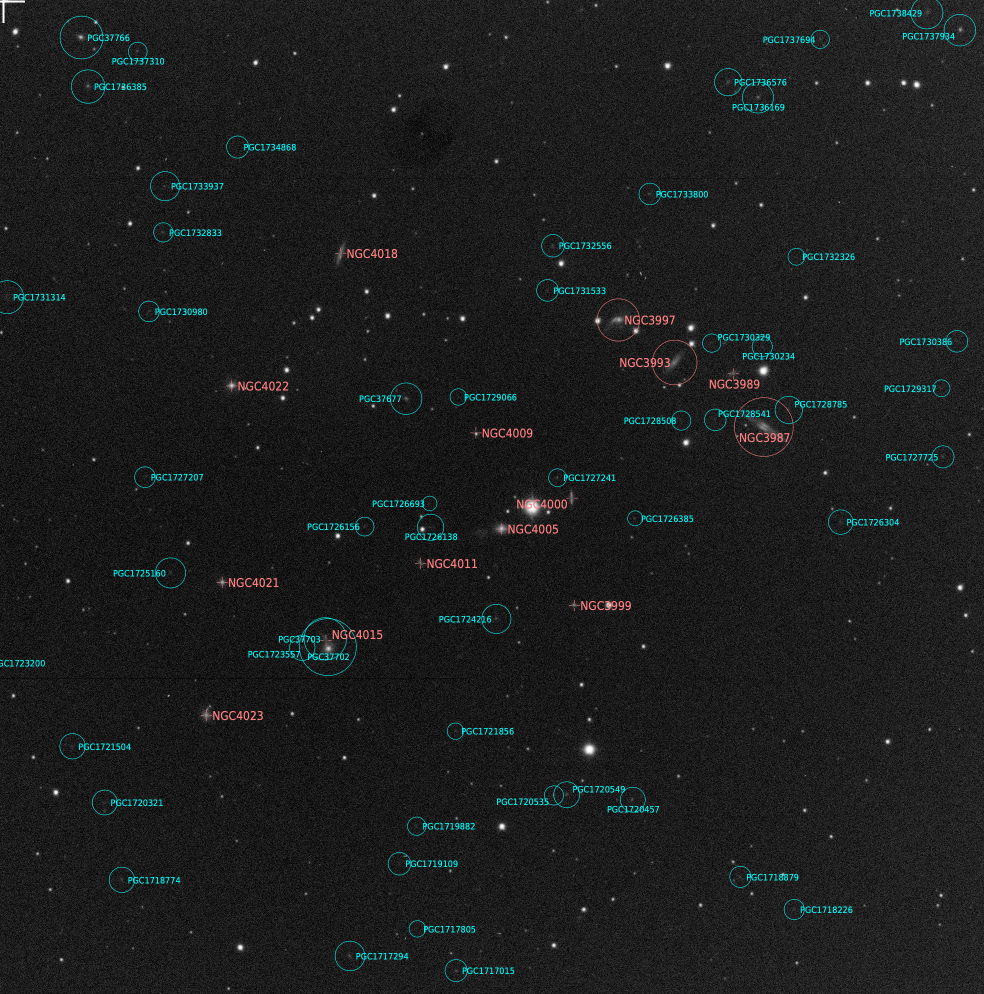
The red annotations are galaxies from the NGC catalog and the green annotations are from the PGC catalog. On occasion, I added stars from the Tycho Star Catalog to the solving setup; they are in yellow on those photos. I decided that for the Abell targets, I would annotate the original photo showing one bright galaxy (or in some cases, a bright star from the Tycho Star Catalog), and also post the same image, only plate solved. With a bit of hunting and close examination, you can find the galaxy I noted in the left photo on the plate solved image on the right to see how they match up. I hope the use of the solved photo gives evidence of how many galaxies are in such clusters.