Imaging Certification
Jack Fitzmier
Projects for the Sun and Moon
SUN: Sunset Azimuth Positions
Photograph where the Sun sets or rises once a week for at least four weeks in the spring or fall and for 6 to 8 weeks in the summer or winter. Note the time, day, month and year of each observation. At what season is the shift most noticeable?
SUN: Solar Eclipse – I photographed the April 8, 2024 solar eclipse from my home in Verona, WI with a Seestar 50. Here is a timelapse I made using my photos:
SUN: Sunspots – I completed the Sunspotter Observing Program (#245-I, 2024-03-26). Click here to see the photographs I took for the program.
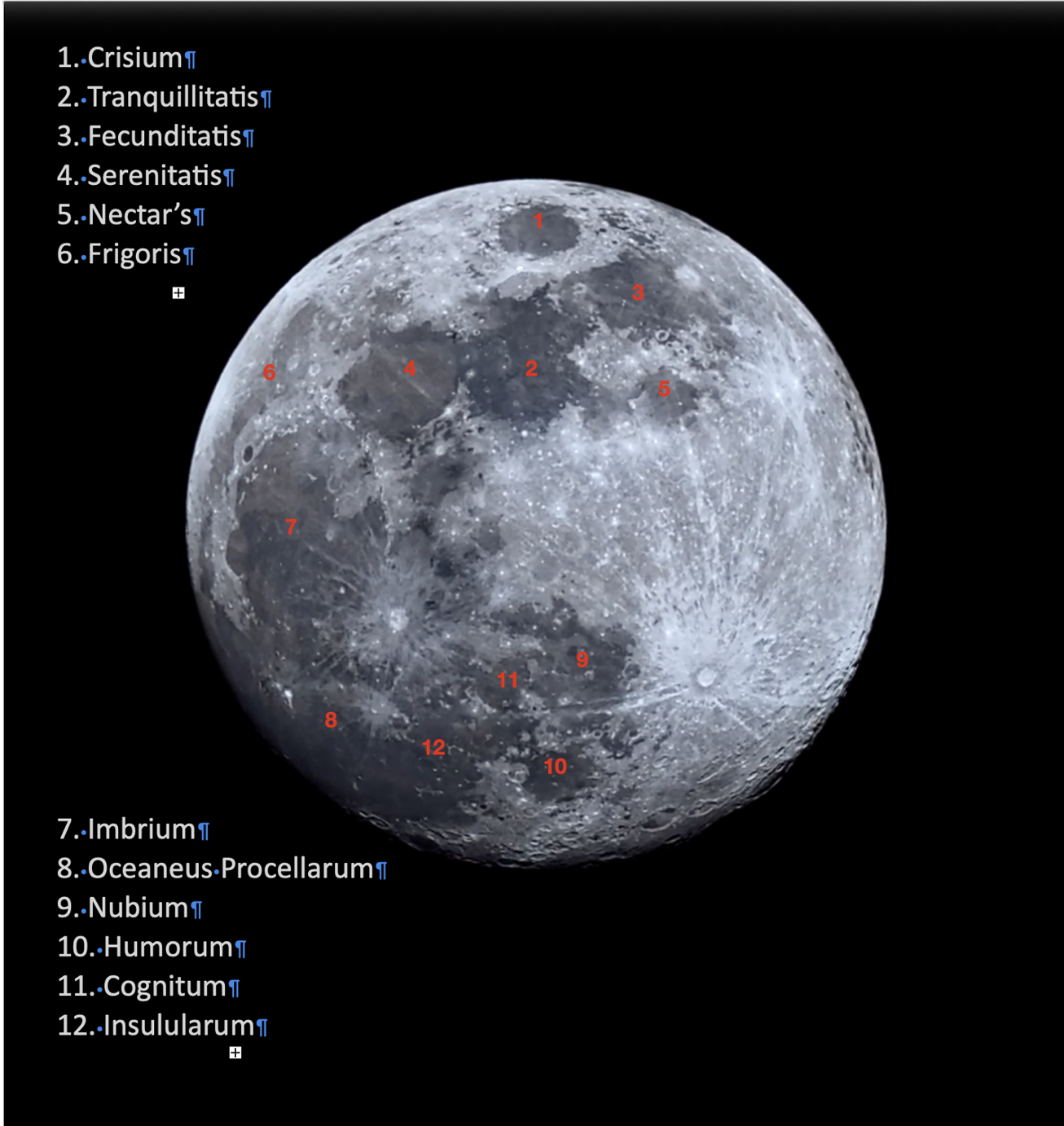
MOON: Maria
Moon: Highlands
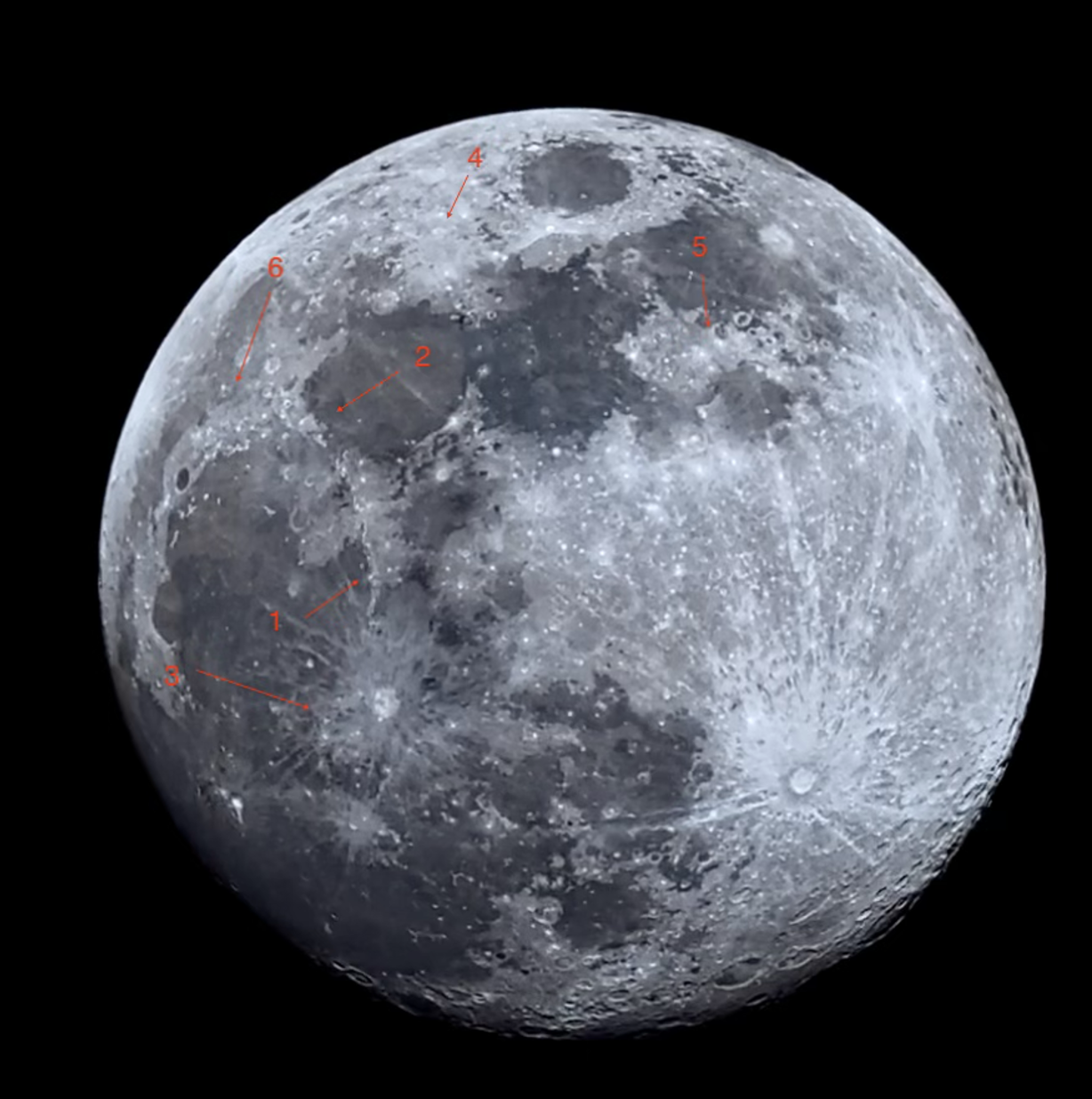
Photo of lunar highlands is from a 22 second video taken with a ZWO Seestar 50 on February 23, 2024 at 00:55 UTC from my home in Verona, Wisconsin. Key to highlands photo:
- Montes Apenninus forms the southeastern edge of Mare Imbrium.
- Montes Caucasus is located between Mare Imbrium and Mare Serenitatis.
- Montes Carpatus borders the southern edge of Mare Imbrium.
- Montes Taurus is located on the east side of the Moon.
- Montes Pyrenaeus separates Mare Fecunditatis and Mare Nectaris.
- Montes Alpes borders the northern part of Mare Imbrium.
Moon: Crater Ages
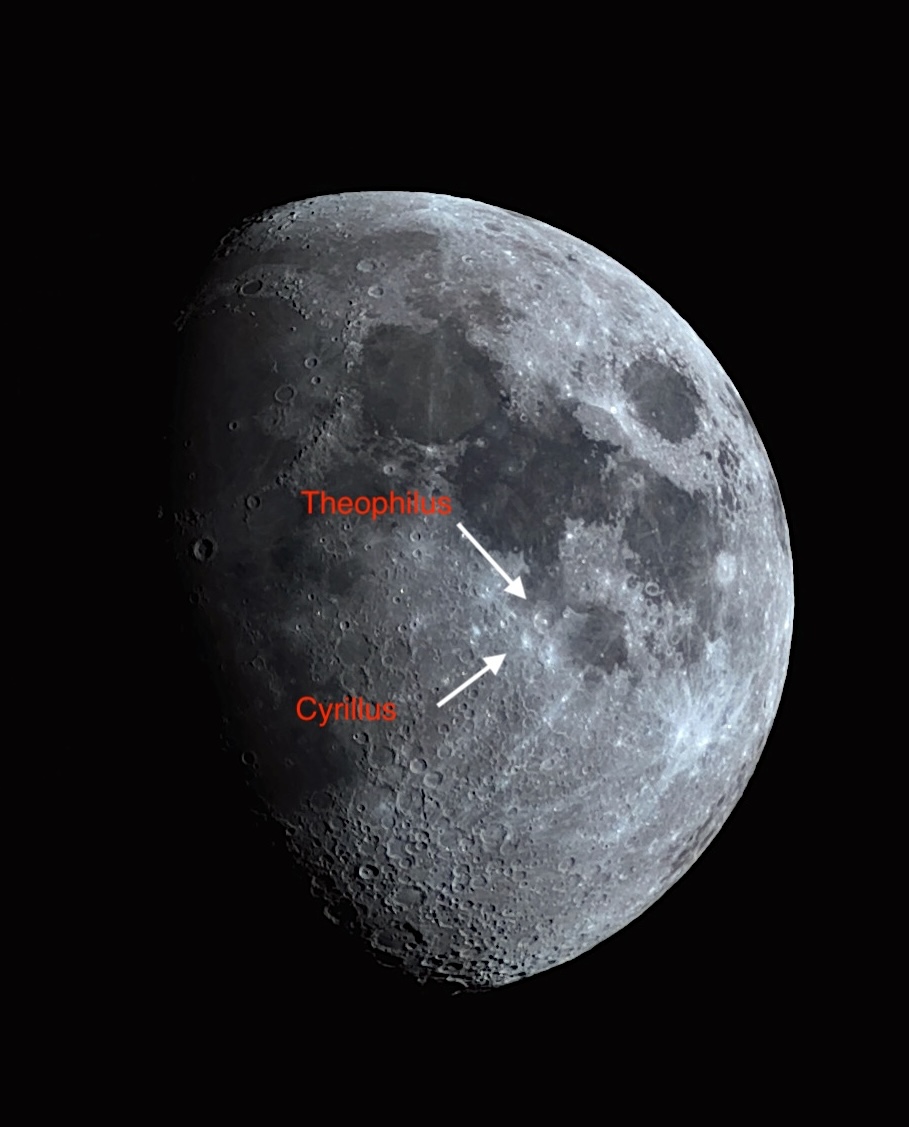
Crater ages photo was from a 31-minute Seestar video taken from my home in Verona, WI on March 26, 2026.
Moon: Scarps
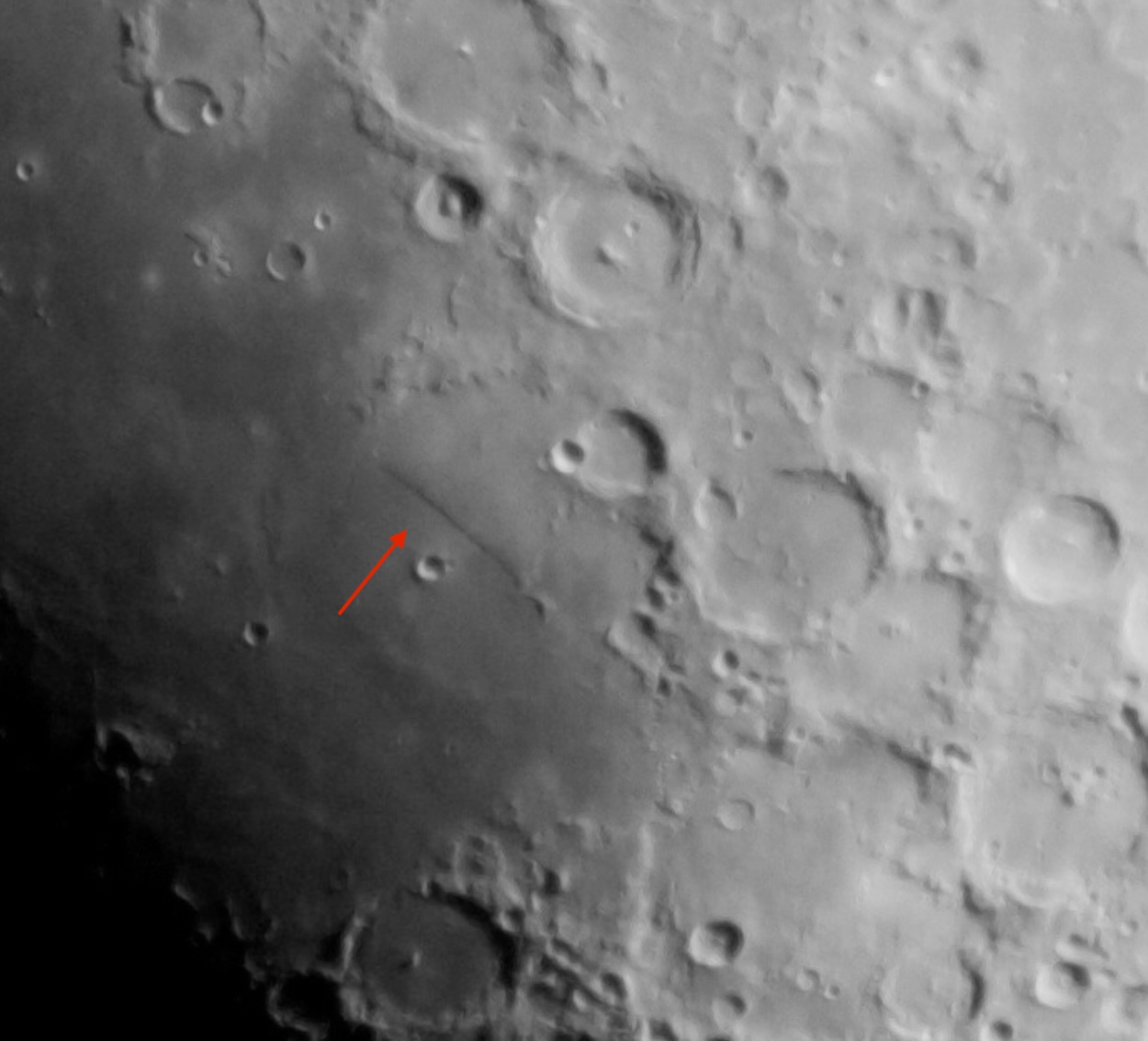
The arrow points to the lunar scarp called Rupes Recta. It is near the Thebit crater system, and is approximately 70 miles in length and is perhaps 1,000 feet tall. This photo was taken on January 20, 2013, 5:35 local, in Decatur, GA, using a Canon T1i camera, a Meade ETX 125 telescope, and a 2x Barlow.
Moon: Occultations
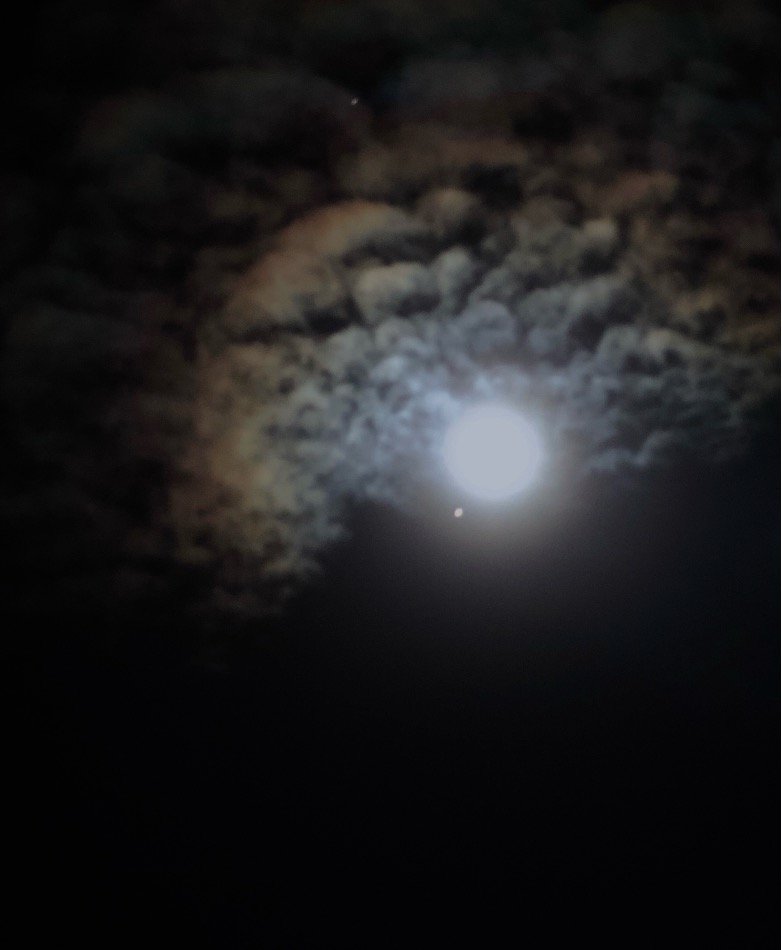
This is not a very good photo! Late in the evening of January 13, 2025, at my home in Verona, WI, I realized that the Moon was going to occult Mars. I grabbed a Canon T1i DSLR camera and went outside just as clouds rolled in to spoil the view. But the photo does show the Moon moving past Mars.
Moon: Lunar Eclipse
Early on the morning of May 26, 2021 there was to be a total lunar eclipse of what is known as the “Super Flower Blood Moon.” I realized this just before the eclipse began, and rushed to my sunroom, iPhone in hand.
The slideshow linked below shows a series of photos taken during part of a Lunar Eclipse. Unfortunately, from my home in Verona, WI the eclipse was partial, not total. At first (see first shot in slideshow) I thought that clouds might obscure the event. But the clouds eventually moved on. The eclipse began at 4:47 AM local time. My final photo, as the Moon fell below the horizon, was taken at 5:14 AM local time. Note the brightening skies through the series. Astronomical dawn was at 3:15 AM local time and Sunrise was at 5:24 local time. The photos (taken with an iPhone) are not of very good quality, but they do show earth’s shadow moving across the face of the Moon. Click here to view the slideshow.
Projects for the Inner Solar System
Mercury Location (*B*, *E*)
Venus: Low Power Crescent (*B*)
Venus: Daytime Observation (*B*, *E*)
Venus: Phases
Mars: Albedo Features
 |
 |
These photos were take by Slooh Chile 1 on 2020-09-12 at 03:51 UTC. R (3 seconds) G (3 seconds) B (3 seconds) With such short exposures I was surprised to see the surface detail that emerged from the integration. But I could not manage to rid the photo of the orange cast on the lefthand photo. I eliminated the color in the right grayscale photo in an effort to maintain the contrast without the orange cast.
Mars: Retrograde Motion (*B*, *E*)
Ceres Locating
For some reason, Slooh did not offer easy way to track Ceres. So I came up with an alternative strategy. The Slooh catalog of stars does allow you to image stars in the SAO catalog. Using Sky Safari, I found an SAO object (SAO 191392) that Ceres would come close to in the night sky on a particular date and time. I was able to have Slooh aim at SAO 191392 and take a photo, and then repeat that process about 4 hours later.
The scheme worked. Because the date and time are embedded in the file name of a Slooh photo, I went back to Sky Safari and confirmed Ceres position relative to SAO 191392 for each photo. (I also did a bit of plate solving to confirm things.). I acquired the RA and Dec data for Ceres’ position in Sky Safari as well, by changing the time to match to time of the photo and then noting the RA Dec coordinates for Ceres.
Click on the photos to enlarge them:
 |
 |
|
Ceres # 1 |
Ceres # 2 |
Asteroids: Course Plotting
Here is another example of how I tracked asteroids using a remote scope. 2 Pallas is a prominent asteroid that I photographed using the Slooh scopes. 2 Pallas has an orbit that is stable and it circles the Sun in about 4.62 years. The photos below (click to enlarge) were taken with different cameras with different fields of view.
 |
 |
|
Pallas # 1 |
Pallas # 2 |
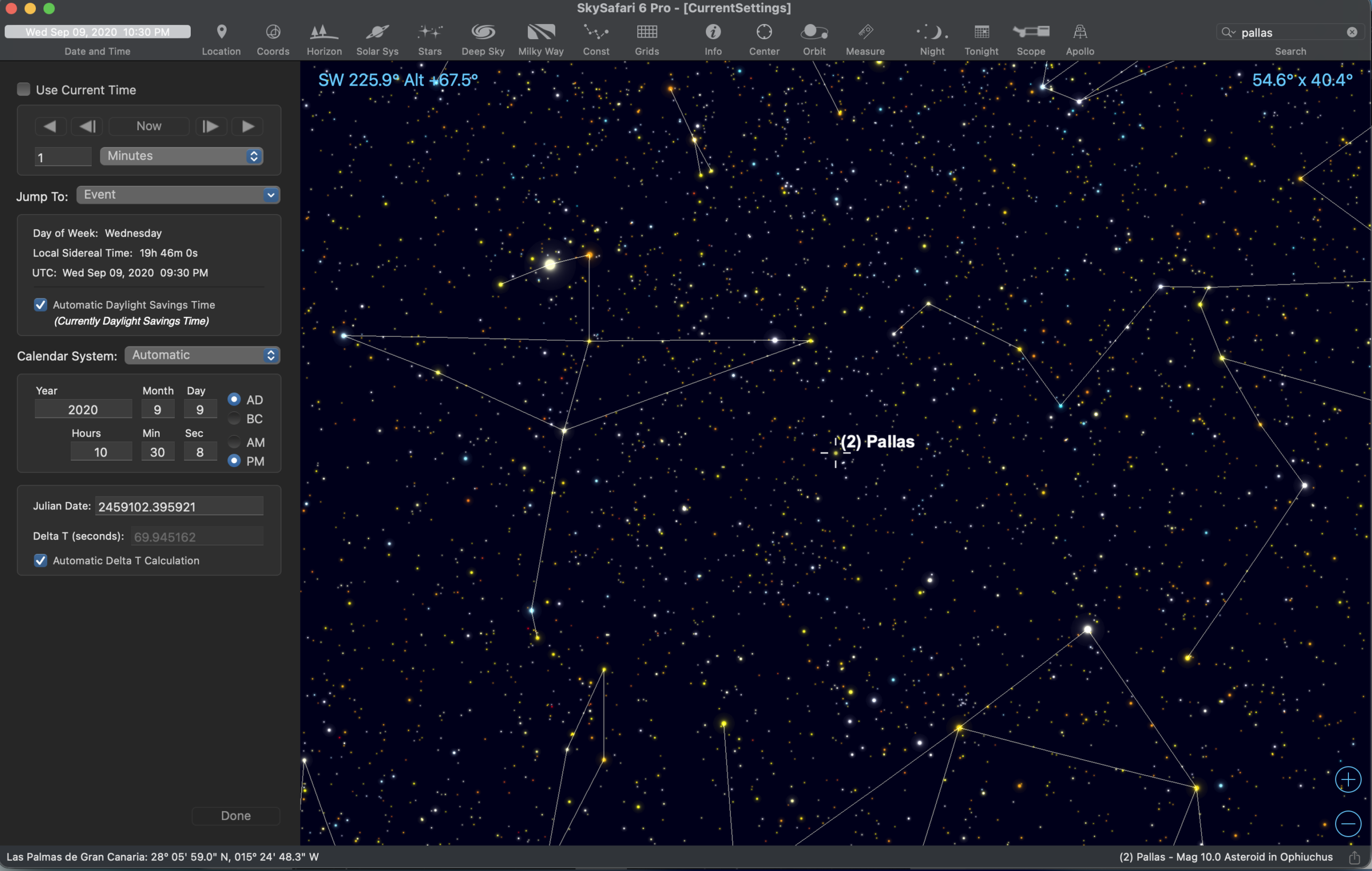
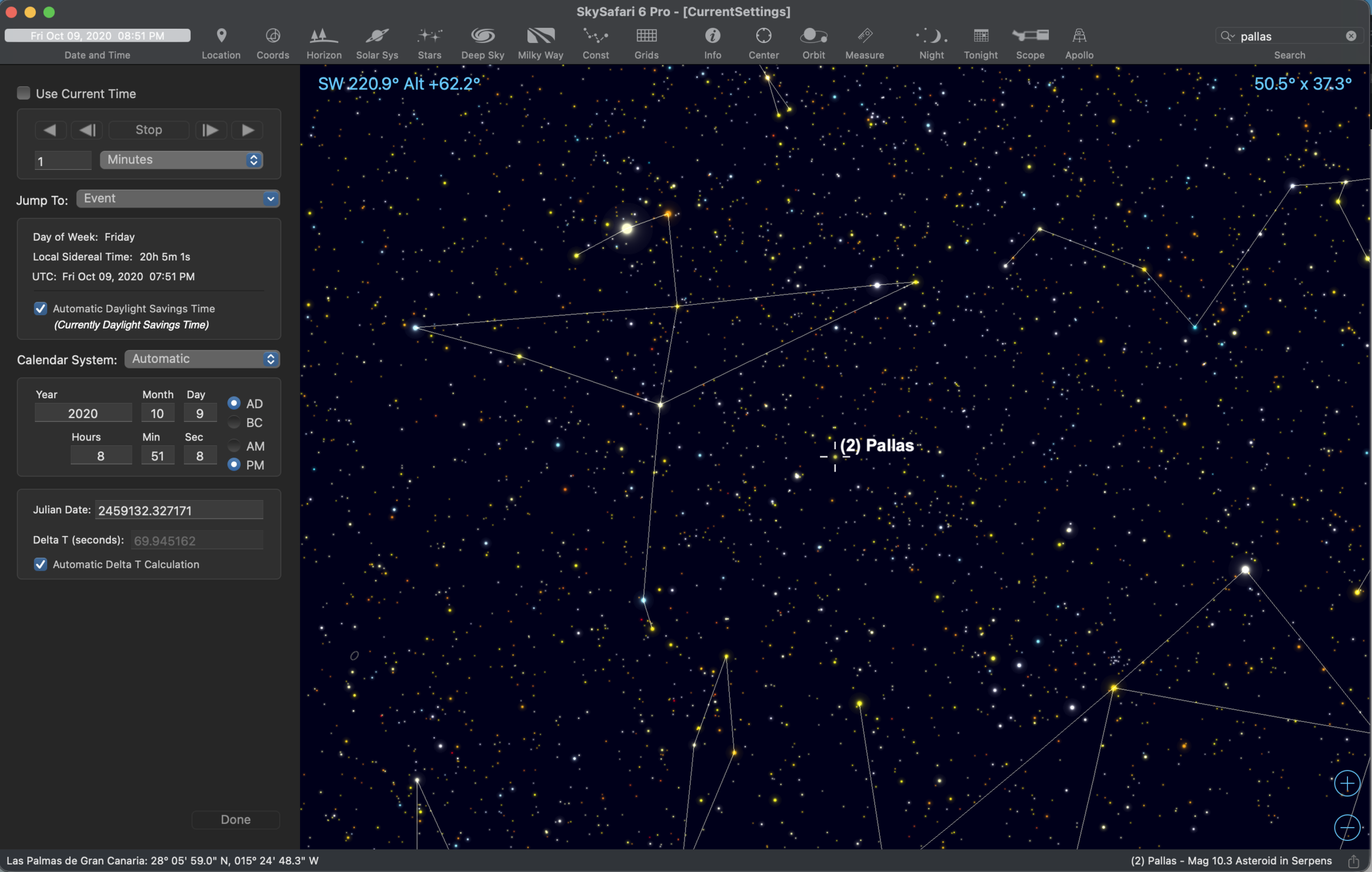
My 2 Pallas photos were shot with different cameras with different fields of view. To get a better sense of the comet’s movement, in Sky Safari I adjusted the location, date, and time to match the photos and took screenshots of each. Click photos to enlarge.
 |
 |
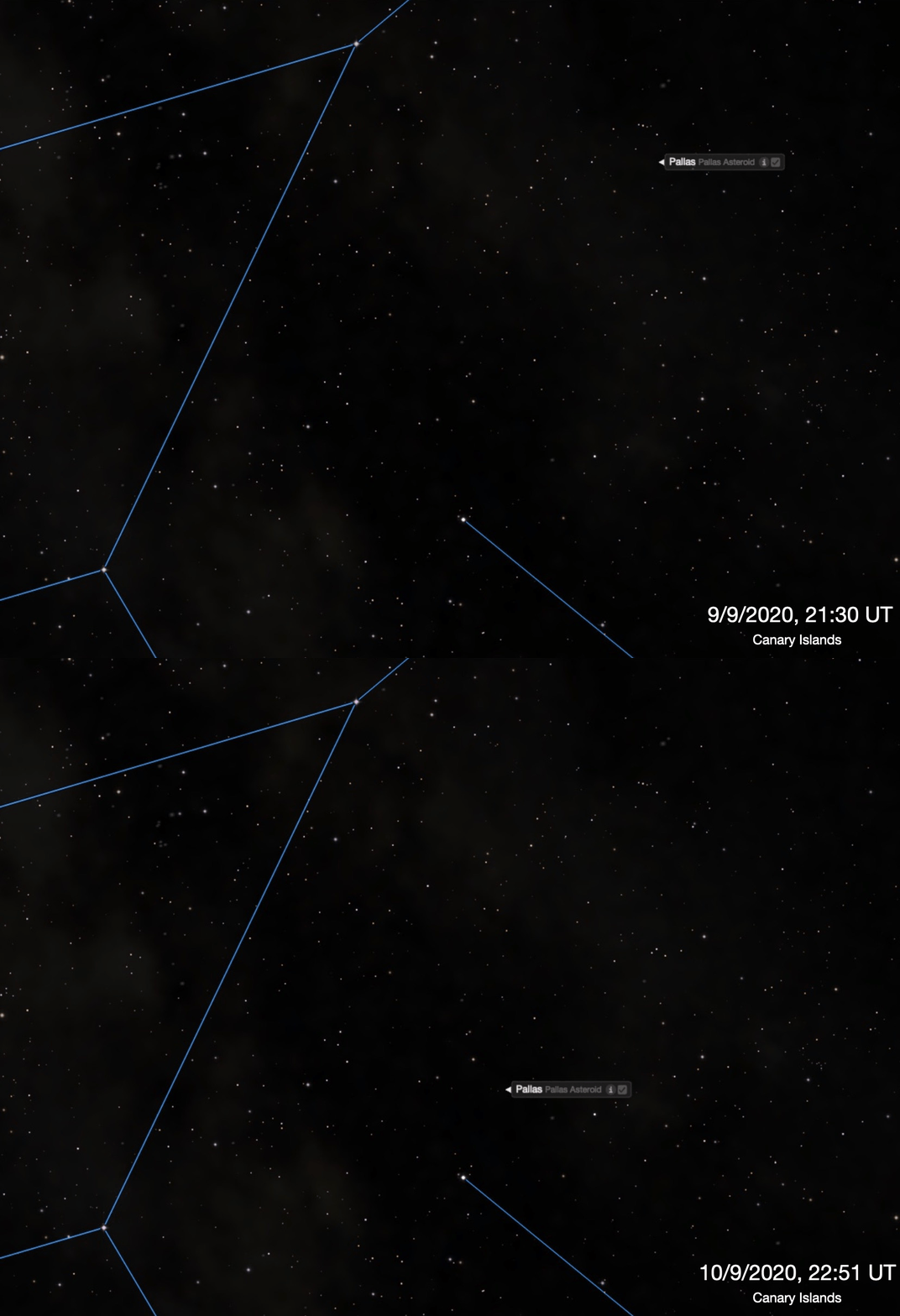
To plot the course of 2 Pallas over a month, I needed some help. Fellow Madison Astronomical Society member John Rummel prepared an animated gif using Starry Night and Photoshop. It “blinks” 2 Pallas as it traveled near the constellation Aquila.
Asteroids: Measuring their Movement
To calculate the angular distance that 2 Pallas travelled in the time that elapsed between the first and second photo, I used the RA Dec coordinates of 2 Pallas at the exact date and time the photos were taken. To do this, I used Sky Safari, which can be set for observation location, date, and time. 2 Pallas was at RA 18h 40 m 44.27 s Dec +11 degrees 33 minutes 33.7 seconds on 9/9/2020 at 21:30 UTC. It was at RA 18 h 53 m 29.14 s Dec +06 degrees 02 minutes 59.4 seconds on 10/9/2020 at 22:51 UTC.
I used two sources to make the calculation (which is fairly complicated!). The first was the AI tool that Google uses, called Gemini. In response to this question “What is the angular distance between these two celestial coordinates: 18h 40 m 44.27 s +11 degrees 33 minutes 33.7 seconds and 18 h 53 m 29.14 s +06 degrees 02 minutes 59.4 seconds?” Gemini calculated the angular distance to be 6.3455 degrees. I checked Gemini against another source, the online calculator at Celestial Wonders (http://celestialwonders.com/tools/starAngleCalc.html). that calculator rendered an answer nearly identical, 6.3457 degrees.
Comet Observing
These are two photos of C / 2020 M3 (Atlas) taken from the Slooh Chile observatory. Left photo was a long luminance exposure, and the right photo was a combination of shorter LRGB exposures.
 |
 |
| C / 2020 M3 (Atlas) # 1 Chile 2 / 2020-09-19 / 06:53 L (3 x 50 seconds) RA 3h 51m 43.30s Dec -35h 5m 43.69s |
C / 2020 M3 (Atlas) / # 2 Chile 2 / 2020-09-20 / 05:16 L (1 x 50 seconds) R (1 x 20 seconds) G (1 x 20 seconds) B (1 x 20 seconds) RA 3h 54m 16.19s Dec -34h 56m 20.04s |
Projects for the Outer Solar System
Jupiter: The Great Red Spot and Cloud Belts

Slooh Canary 4 on 2020-09-06 at 21:10 UTC. The composite photo is made from three very short exposures: R (1 x 3 seconds), G (1 seconds), and B (1 seconds). To get any detail I had to do a good deal of processing in Pixinsight and Apple Preview. The red spot was centered on the CM at 22:11, about an hour after the photo was taken. North is almost directly at noon; East is at 9 o’clock. Click to enlarge photo.
Galilean Satellites
For this exercise we will only ask you to sketch the satellite positions on the this page for six consecutive nights identifying each satellite in your sketches. Include a copy of them in your report. As much as possible, try not to skip more that one night between consecutive viewings. The “Jupiter’s Moons” chart in the Almanac section of astronomy magazines each month will help you to identify the individual moons.To show the East-West direction of your sketches show with an arrow the direction of drift in your field-of-view without a drive running.
To show the East-West direction of your sketch show with an arrow the direction of drift in your field-of-view without a drive running.
Jupiter: Satellite Discovery (*B*)
On January 7, 1610 Galileo Galilei observed the planet Jupiter with his fourth and latest telescope. He had “spared no time and expense” in its production. With it he saw three small bright stars near the bright planet and assumed that they were fixed background stars. The next night he observed the Jovian planet again and was amazed to discover that the “stars” had changed their positions relative to the planet’s disk. Very perplexing! Within a week he had seen all four of what we now call the Galileian satellites of Jupiter.
Galileo was using a primitive simple telescope magnifying about twenty times. Can you duplicate his feat with the modern lenses of a pair of binoculars?
It is important that the binoculars be held perfectly steady for the eye to pick out the tiny moons next to Jupiter’s glare. Any movement, even the blood pumping through your veins will make them difficult to see. Try bracing your binoculars against a solid structure like a telephone pole or the roof of a car. Better yet, mount them on a tripod. Observe the satellites for several days and then describe your experience.
Jupiter: Satellite Shadow Transits
Shadow transits occur quite often and are a phenomenon that can easily be seen by the amateur. The shadows cast by the Galilean satellites are seen as tiny black dots slowly proceeding across the cloud tops of the giant planet.
Your task is to determine which of the four largest Jovian moons is casting the shadow. First you need to know if Jupiter is approaching its yearly opposition or if opposition has already passed. If Jupiter is moving toward its opposition then the shadow precedes the satellite. The moon’s shadow will fall on the planet while the moon itself is still nearing the planet’s limb. If opposition has passed, the moon will cross the planet’s disc first, followed by its shadow. By consulting a Galilean Satellite Chart in an astronomy periodical you should be able to determine which satellite is casting the shadow. Which satellite was it?
Jupiter: Satellite Transits
Watching the Galilean Moons transit the disk of Jupiter is considerably more of a challenge than watching their corresponding shadows. The tiny little disks are similar in color to their parent planet so the satellite quickly gets lost from view in its frontal passage. The satellites can often be seen under the right conditions with larger apertures, for a few minutes, while still on the edge of Jupiter’s limb. The limb tends to be slightly darker than the face of the planet itself. The contrast between the two helps the satellite to show up. The slow ingress or egress varies with each satellite. Io and Europa, being inner satellites, take only about two and a half minutes to ease onto or off of Jupiter’s limb. Ganymede moves much more slowly, taking seven minutes, and Callisto crawls across the limb for nine minutes. If you are able to detect these ingresses or egresses, time them with a stop watch and compare the times with those just given. An alternative project would be to time the ingress or egress of one of the satellites into or out of Jupiter’s shadow. What satellite did you time?
Jupiter: Satellite Eclipses: Eclipses of the Galilean satellites occur as they move into or out of Jupiter’s shadow. This is different than an Occultation (see next requirement). Time the disappearance or reappearance of one of these satellites by using a radio tuned to the WWV National Time Standards signal out of Ft. Collins, Colorado. Then compare it to the time printed in the astronomy periodicals. Note the time when the satellite completely disappears into or reappears from behind Jupiter’s shadow. Timing a reappearance is much more difficult since you do not know precisely when or where it will appear. Note the name of the moon that you observed.
Jupiter: Satellite Occultations: Occultations of the Galilean satellites occur as they move behind or out from behind the planet Jupiter. This is different than an Eclipse (see previous requirement). Time the disappearance or reappearance of one of these satellites by using a radio tuned to the WWV National Time Standards signal out of Ft. Collins, Colorado. Then compare it to the time printed in the astronomy periodicals. Note the time when the satellite completely disappears or reappears from behind Jupiter. Timing a reappearance is much more difficult since you do not know precisely when or where it will appear. Note the name of the moon that you observed.
Saturn: The Rings, the Cassini Division, and Disk Markings
These photos are not the result of “lucky imaging,” where a video is shot and then the best frames are stacked. Instead, Slooh scopes take individual images (one Red, one Green, one Blue, each a 2 second exposure) that can be stacked with Pixinsight.
The left photo was taken with the Slooh Canary 4 scope on 2020-09-13 at 20:23 UTC. Using different techniques in the stacking and processing, I was able to bring out the disk markings on Saturn’s face and the shadow it casts on the rings on the left side of the limb.
The right photo, taken with the Slooh Chile 2 scope on 2020-09-19 at 23:50 UTC, was dominated by Green, which I reduced by about 50%, which greatly improved the image. Again, you can see both the disk markings and the shadow. Note the clearer view of the Cassini Division between Rings A (outer) and B (inner).
 |
 |
Saturn: The Satellites. How many can you photograph?
Uranus Locating — Use Seestar to locate Uranus. Try for 2 photos, to show movement.
Neptune Locating – Use Seestar to locate Neptune. Try for 2 photos, to show movement.
Pluto Locating
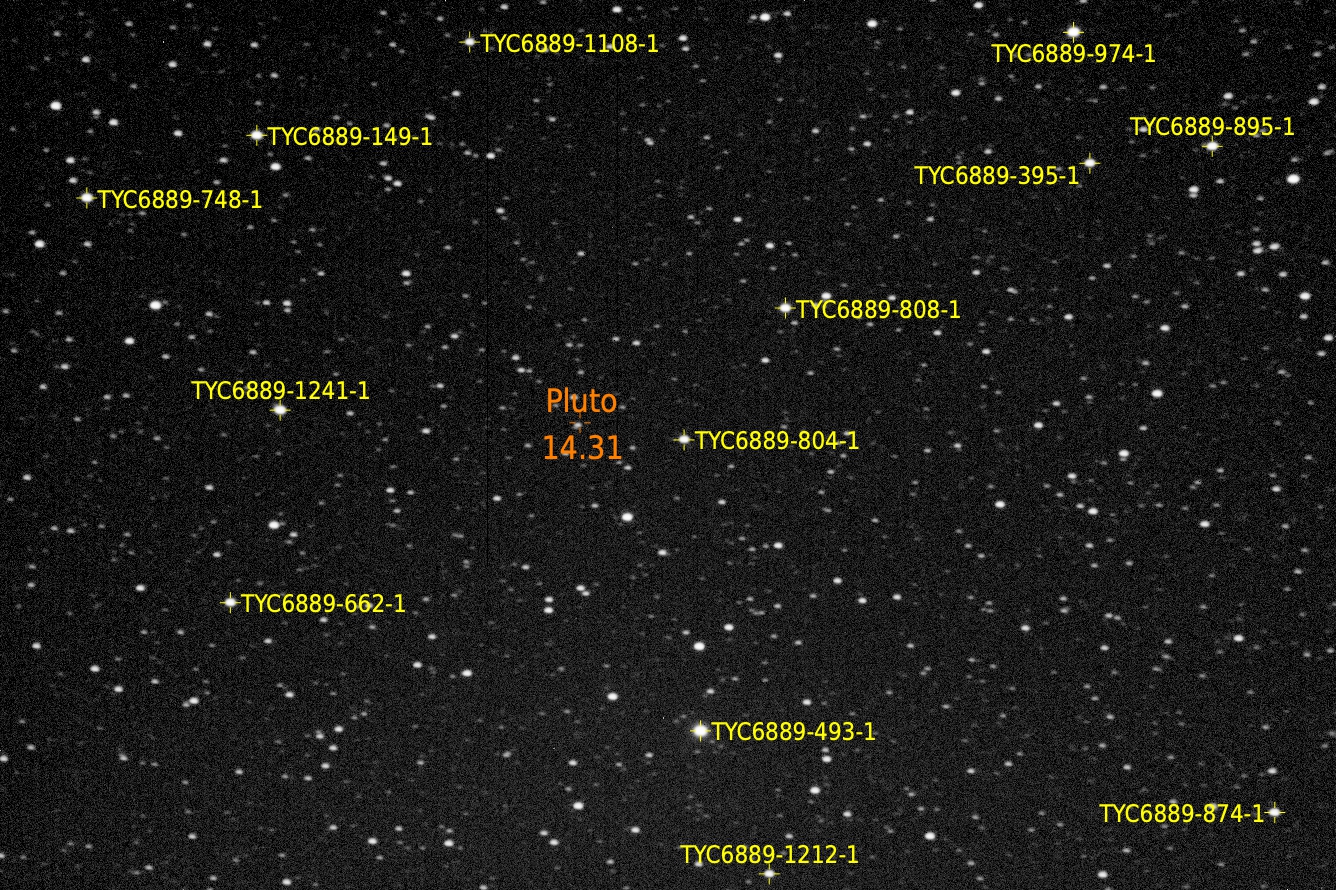
This photo of Pluto was taken with Slooh / Chile 1 on 10/4/2020 at 00:19 UTC. It is a luminance shot of 50 seconds duration. I verified that presence of Pluto using Pixinsight’s solving and annotation functions.